What if resilience is less about executing the 'right strategy', and more about a different kind of listening?
... a kind of listing that tunes into the continuous stream of intelligence your body is already broadcasting?
I call this type of listening (and broadcasting) 'vibrational availability'
What is Vibrational Availability?
Vibrational availability is the ability to attune to present-moment, live data that helps us be more accurate to what's actually unfolding right now.
It's about staying open to learning from the micro-fluctuations and micro-signals happening in our body-brain system, rather than narrowing our focus onto what we already predict will happen.
Your vibrational availability also transmits out signals to others that you are open and responsive to the signals and frequencies they are transmitting - so that you can use this as live data for tuning in to what is emerging, micro-moment by micro-moment.
Trusting in Emergence
Here's where things can feel uncomfortable and/or counterintuitive:
expanding your nervous system's range requires surrendering to your brain-body signals and what unfolds as you iterate and adjust... rather than trying to fit things into your expectations or resist what might be happening (even if it feels uncomfortable).
This means getting more comfortable with attuning to micro-feedback and adjusting using micro-adaptations. Not perfectly pre-engineered actions.
Not overly rigid protocols. Tiny, responsive iterations based on what you're sensing right now.
What This Actually Looks Like
Let me give you some concrete examples. Say you're about to have an interaction with someone who typically challenges you:
Before the interaction:
- Slow down your eyeball movements momentarily. Notice—what are your eyes actually doing? Are they darting? Fixed? Soft? Hard?
- What are your hands doing? Are they clenched? Open? Gesturing? Still?
- What's your body posture telling you? Are you braced? Collapsed? Expanded? Contracted?
- Whatever you notice, play with a small adjustment: hands clenched? Try to open them. Eyes fixed on something? Try moving them. Eyes darting around? Try letting them land and gaze at something more slowly.
During the interaction:
- Can you maintain some thread of awareness on these same signals while you're engaged?
- What micro-shifts are happening in real time? Does your chest tighten when they say certain things? Do your shoulders rise? Does your breath become shallow?
After the interaction:
- What sensations linger? What's the vibrational pattern you are still feeling?
- What does your body seem to need—movement? Stillness? Expression? Space?
This isn't about judgment. It's about data collection.
Your brain-body system is giving you continuous feedback about what it's detecting and what it might need to maintain or regain flexibility.
Working With Prediction Errors as Intelligence
When you feel a way you don't want to feel, your brain-body system is generating data in the form of fluctuations and vibrational patterns. These aren't problems to solve—they're signals to decode.
What do those vibrational signatures tell you about what you could iterate in that moment?
Here's the crucial part: there is no golden ticket, one-size-fits-all answer to that question.
Sometimes the iteration that creates more flexibility looks like:
- saying something vulnerable or brave.
- offering kindness or humor.
- taking a breath and giving space instead of saying anything at all.
There is no "right" or "wrong" move. There's just the iteration—some type of movement, action, or expression—and staying open to the feedback that comes back. And then adjusting, continuing, enhancing, or switching your next move based on that feedback.
This is resilience. Not 'try this thing and it'll be smooth sailing forever'.
Not rigidity. Not perfection.
Responsiveness.
5 Neuro-Tools to Prime Your Brain for Vibrational Availability
So how do you cultivate this capacity?
- Practice Micro-Awareness
Start small. Throughout your day, drop into brief moments of body awareness:
- What are three sensations you can notice right now?
- What's the quality of your breath—shallow, deep, held, flowing?
- Where do you feel tension? Where do you feel ease?
You're not trying to change anything. You're just practicing the skill of tuning in to the live data your system is generating.
2. Get Curious About Discomfort
The next time you feel uncomfortable—anxious, irritated, deflated, whatever—pause before you reach for your go-to regulation strategy. Instead, ask:
- What is this sensation trying to tell me?
- What data might this be?
- If this feeling were intelligent (which it is), what might it be detecting?
You're training your brain to see uncomfortable signals as information rather than problems.
3. Experiment With Micro-Iterations
When you're in a challenging moment, try making tiny adjustments:
- Shift your posture slightly
- Change the pace of your speech
- Adjust your eye contact
- Take one conscious breath
- Move your hands differently
Then notice: what happens? What feedback does your system give you? What feedback does the environment give you?
You're building your capacity to work with live, raw data and adjust in real time.
4. Let Go of the "Right" Response
This might be the hardest part: releasing the idea that there's a perfect way to regulate, a correct way to respond, a gold standard of emotional management.
Your nervous system doesn't work that way.
It works through iteration, feedback, and adaptation. Sometimes the "wrong" move teaches you more than the "right" one ever could.
5. Invite the Gift of Range
Stay open to a mindset that explores this idea: When you expand your nervous system's range—you don't become impervious to challenge.
You don't stop feeling uncomfortable.
You become responsive. Adaptive. Fluid.
You develop the capacity to meet whatever arises with curiosity rather than rigidity.
You learn to trust the intelligence of your brain-body system to guide you through complexity.
You discover that resilience isn't about staying calm—it's about being able to move through the full spectrum of human experience without getting stuck.
This is the work. Not finding the formula... developing the flexibility.
Not achieving mastery... embracing the ongoing practice of attunement, discovery and iteration.
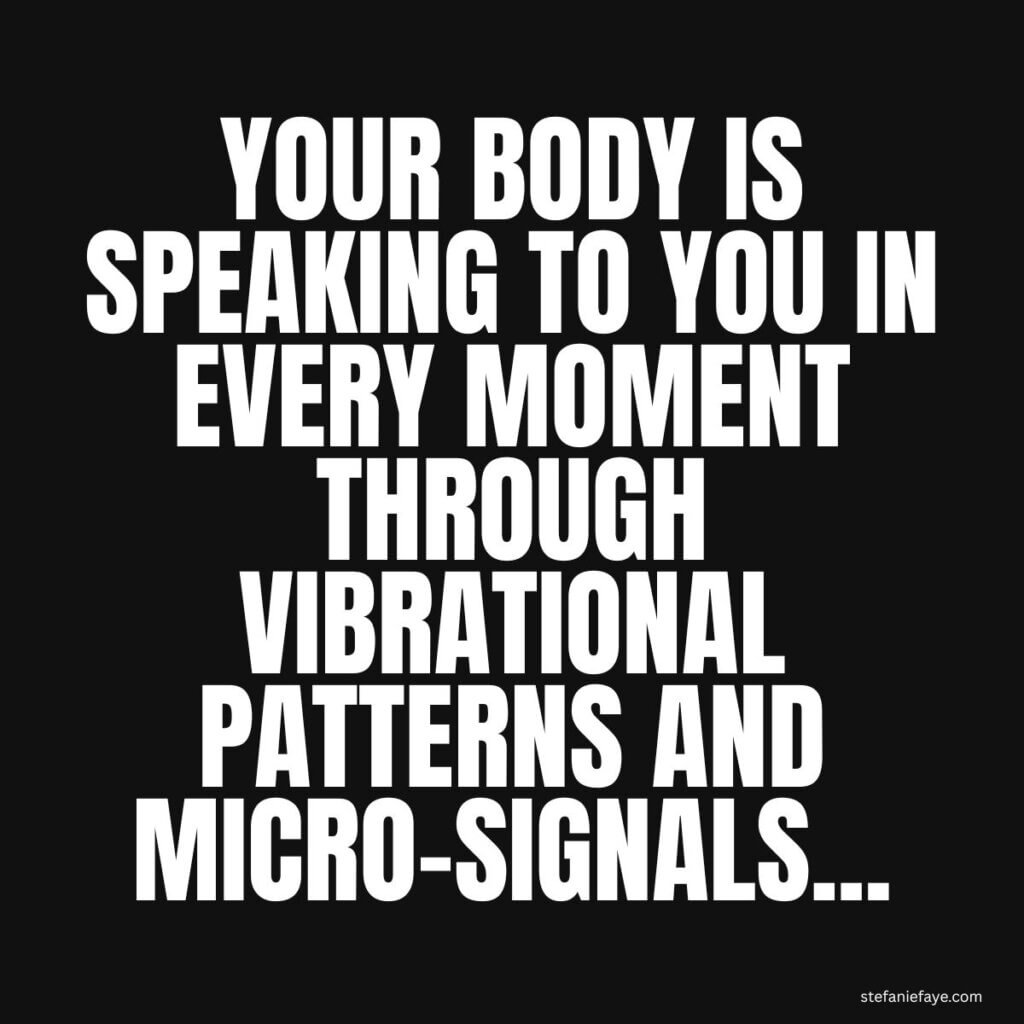
Your body is speaking to you in every moment through vibrational patterns and micro-signals.
The question isn't whether you'll listen. It's whether you'll trust that what you're sensing is intelligent—even when it's uncomfortable—and let that intelligence guide your next iteration.
That's where real resilience lives.