There's a moment, right before we reach for the answer, when something else is available to us.
The next time a new idea unsettles you, or you notice yourself wanting the tool, the formula, the instruction for what to do next... sit with it just a little longer.
Let the brain activity fluctuate and flutter.. try this without grasping for the next thing to do or say about it.
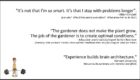
This is how we work with actual paradigms and mindsets. It's less about a specific tool, strategy or thing to do. More about how we 'see'...
We work with the idea that there are conditions we can cultivate and nurture - a 'vibrational environment'... that allow new signals to connect, systems to link up, new perspectives and ideas to emerge.
When we jump too quickly to wanting an answer, we risk robbing ourselves of the very brain activity that might allow something new take shape.
Insight researchers have found that before an insight arrives, the brain quiets and turns inward, briefly releasing its grip on the problem... as though the letting go is what clears the space for the new connection to form. (Kounios and Beeman, 2015)
Paradigm and Mindset work asks for a different kind of interaction with the people, situations and information around us:
... allowing 'data' to emerge and unfold in its own way,
...and staying open to multiple possibilities of what it means, how it might serve us, what seeds it might plant that can open us up to new ideas and responses.
... instead of narrowing in on the interpretation our predictive algorithms already led us to.
Concrete tools and strategies absolutely serve a purpose. It's context dependent. A deeper key to resilience is found in flexible adaptation, in response to what's constantly emerging.
----
This week, notice what happens in your body the moment you feel the pull toward the quick answer, the concrete tool, instruction, strategy...
What happens if you wait?
----
Wishing you insights that sometimes come from letting go of what we think we need so that space is created for what might truly serve us...
Stefanie
---
P.S. Two modules of The Neuroscience of Growth Mindset micro-course sit right at the heart of this: one explores how our predictive brain quietly narrows what we let ourselves perceive, and another looks at how a single situation can hold more than one meaning... and how staying open to that is a skill we can build in ourselves and others.
References and further reading:
Kounios, J., & Beeman, M. (2009). The Aha! moment: The cognitive neuroscience of insight. Current Directions in Psychological Science, 18(4), 210–216. https://doi.org/10.1111/j.1467-8721.2009.01638.x
Kounios, J., & Beeman, M. (2014). The cognitive neuroscience of insight. Annual Review of Psychology, 65, 71–93. https://doi.org/10.1146/annurev-psych-010213-115154
Kounios, J., & Beeman, M. (2015). The Eureka factor: Aha moments, creative insight, and the brain. Random House.
Here is an excerpt from a program that had a profound impact on me as a school and family counselor (founded many years ago by one of my favorite teachers and attachment researchers, Gordon Neufeld):
De-emphasis on skill acquisition
Our primary objective should NOT be to learn what to do but rather how to see, NOT to acquire skill but rather to glean insight. Likewise in helping others, our primary objective should not be to teach people what to do with their children but how to see their children. Our primary instrument of influence, therefore, should not be through offering strategies but removing blindness.