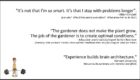
Your neural circuitry often needs something before it needs a solution..
There's a moment right before we reach for an answer, when a different form of brain activity is available to us.
It's brain activity that allows us a chance to notice something we might have missed, or a new connection or possibility to emerge.
When we jump too quickly to wanting an answer, we risk robbing ourselves of the very brain activity that might allow something new take shape.
Insight researchers have found that before an insight arrives, the brain quiets and turns inward, briefly releasing its grip on the problem
... as though the letting go is what clears the space for new connections to form. (Kounios and Beeman, 2015)
One of the most powerful things we can learn about the human brain is how to see the bigger picture of what it's doing… before we attempt to control it.
Over the years, I've had the honor of analyzing and working with many different types of brain maps.
When I share examples of these maps in my courses, we explore them through the lens of adaptability and how the brain changes over time.
We consider how...
- someone's experiences and history may have shaped the patterns we're seeing,
- what those patterns might be helping that person accomplish, and
- what might be possible as that brain continues to learn and adapt.
The maps become a way of seeing something bigger.
And this is what I hope to cultivate through my sharing of what i've learned from neurophysiological observations and the experiences of people across various contexts, life stages and challenges...
A way of seeing human experience through the lens of embodied systems thinking.
To explore...
- how brains and nervous systems are built,
- how they carry our histories into the present,
- how they continuously respond to the environments, relationships and experiences around us
- how something that appears to be a problem in one context might have served an important adaptive purpose in another,
This can help us recognize when certain types of brain-body activity might serve a moment better than another...
Maybe it's...
- reflecting and turning inward
- stepping away and distracting ourselves from a problem
- fully immersing ourselves in thinking about the challenge
- experimenting with a new response
All of these allow very different types of brain activity to emerge and unfold..
There's a beautiful dance between understanding how our systems work and allowing ourselves to experiment with what happens next.
The richer our understanding of the system we're working with, the more possibilities we can begin to see.
One of my favorite teachers, attachment researcher Gordon Neufeld, profoundly influenced how I think about this.
In a program I studied years ago as a counselor, he emphasized the importance of learning how to see*.
When we zoom in too quickly on finding the correct technique or solution, we can miss the patterns and connections that would help us understand what might actually be useful.
And I think this offers us a beautiful reminder of the importance of giving our minds room to explore.
A small invitation for today…
The next time you notice yourself reaching for the answer, the strategy or the tool, see if you can stay with the bigger picture just a little longer.
- What else might be happening here? What connections haven't I considered?
- What might I see if I gave myself a little more room to explore?
The ability to see a wider picture gives us more possibilities for what happens next
Wishing you moments of pauses, wondering and new ways of seeing…
Stefanie
P.S. A little more about the science of seeing the bigger picture…
I recently shared some reflections on Embodied Systems Thinking in New York Weekly, exploring the extraordinary possibilities that emerge when we understand more about how our minds and nervous systems work.
Read my New York Weekly article →
This is the essence of what I'm teaching across all of my neuroscience courses.
We begin with an understanding of how the mind-brain-body system works, and use that understanding to become more curious, flexible and intentional in how we navigate our own lives and help others navigate theirs.
It's a way of bringing neuroscience into our lived experience, so that our understanding of the brain becomes part of how we perceive the world and participate in it.
Explore my applied neuroscience courses
Each course offers a different lens on human experience, grounded in the science of how our brains and nervous systems learn, adapt and change.
- Teach the Nervous System™: Make the neuroscience of regulation understandable, credible and useful to the people you serve.
- The Adaptive Brain: Science of Setbacks, Mindset & Change: Explore how predictive processing, and brain activity shape our nervous system responses in response to mistakes, failure, rejection - and learn how we build capacity for moving through discomfort, challenge, learning and change.
- Optimize the Brain - Brain Science Foundations Toolkit : A collection of 9 Seminars to help you build a deeper understanding of the brain science beneath human experience and transformation.
- Super-Regulators™ Neuroscience Academy : Explore the mind-brain-body system through multiple scientific lenses and develop the language and frameworks to help others understand the depth and value of your work. Includes all 2026 courses.
References and Further Reading
Kounios, J., & Beeman, M. (2009). The Aha! moment: The cognitive neuroscience of insight. Current Directions in Psychological Science, 18(4), 210–216.
Kounios, J., & Beeman, M. (2014). The cognitive neuroscience of insight. Annual Review of Psychology, 65, 71–93.
Kounios, J., & Beeman, M. (2015). The Eureka factor: Aha moments, creative insight, and the brain. Random House.
Here is an excerpt from a program that had a profound impact on me as a school and family counselor (founded many years ago by one of my favorite teachers and attachment researchers, Gordon Neufeld):
De-emphasizing skill acquisition
Our primary objective should NOT be to learn what to do but rather how to see, NOT to acquire skill but rather to glean insight. Likewise in helping others, our primary objective should not be to teach people what to do with their children but how to see their children. Our primary instrument of influence, therefore, should not be through offering strategies but removing blindness.