Some of our most powerful brain capacities are built, strengthened and expressed in relationships with other human beings.
We need other nervous systems.
And yet…
other nervous systems can also be some of the most dysregulating things we encounter. 🙂
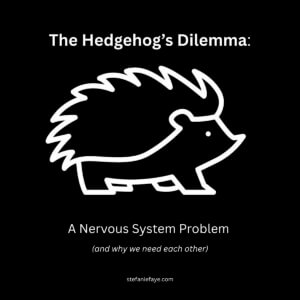
German philosopher Arthur Schopenhauer used the term the 'hedgehog's dilemma' as a metaphor about the challenges of human intimacy.
Although hedgehogs may seek to move closer to one another, they cannot avoid hurting each other with their protective spines.
Imagine a group of hedgehogs on a freezing winter night.. They need to move close enough together to share warmth.
But when they get too close, their quills keep them from getting close enough for real, embodied closeness.
We need closeness. It is a biological imperative of the human condition.
… But closeness also creates vulnerability.
We want to be understood, supported, seen, loved, accepted.
… But relationships can also expose us to disagreement, misunderstanding, disappointment, rejection, conflicting needs and moments when another person's nervous system is doing something very different from what ours would prefer.
This is one of the reasons I think learning to regulate our own nervous systems is so important.
Not so we can become islands.. Completely independent humans who never need anyone else.
We can learn to become better at self-regulating so we can bring greater regulatory capacity into our relationships.
So we can notice what might be getting triggered within us, recover when something knocks us out of balance, and stay flexible in a learning mode when another person's signals aren't what we wanted or expected.
So we can attempt to repair after an interaction doesn’t go well.
And become increasingly skillful at using one of the most powerful regulatory resources human beings have:
each other.
Regulation happens inside a person, yes.
And it also happens (and has to happen) between us.
We are vibrational-relational beings.
Our voices have frequencies, our movements (face, voice, breath, posture) affect the vibrations that are emitted from us and detected by another.
Our nervous systems are continuously sending and receiving information through these exchanges.
And sometimes another nervous system can offer ours something we might have a hard time accessing on our own…
- A slower rhythm.
- A different perspective.
- A feeling of being seen.
- A signal that says: something difficult happened between us… and we can still find our way back.
This is co-regulation.
And I think one of the most beautiful possibilities of becoming better at self-regulation is that we don't just become more capable of navigating our own nervous system.
We become more capable of participating in the regulation, resilience and wellbeing that can happen between nervous systems.
From a human perspective, it’s not easy being a hedgehog..
And we don’t want to always be in proximity. This is not about enmeshment..
It’s about become better at what might serve us and others most at different times..
finding autonomy, separation, closeness, communication, adjustment and repair that allows us to stay connected without losing ourselves in the process.
Wishing you relationships that help your nervous system become more of what it is capable of becoming,
Stefanie
Inside Teach the Nervous System™, we explore the science beneath the signals we are constantly transmitting and receiving.. including the vibrational nature of voice, movement and other forms of information that can shift what happens inside another person's mind-brain-body system.
9 short modules. Instant access. Lifetime access. $44.
Inside Optimize the Brain - Science Toolkit - we explore the neuroscience of relationships inside 2 seminars: Attachment and Affiliative Hormones and Relational Resilience.
We also go much deeper into the neuroscience of regulation and relationship in Weeks 4 and 5 of the Super-Regulators™ Neuroscience Academy,
In Week 4 we'll explore self-regulation and adaptation .. including what it actually means to become more flexible in how our nervous system responds as demands and environments change. (read more about it here)
Then in Week 5, we'll turn toward attunement, attachment, co-regulation and relational resilience.
We'll explore ideas like rupture and repair, what it means to internalize a secure attachment figure (from a brain-body systems perspective), and how our relationships can become places where nervous systems learn new brain activity patterns, rather than simply repeat old ones.
And you don't have to join the live experience to go through this work.
The Digital Academy includes the complete six-part Academy curriculum + access to all of my 2026 neuroscience micro-courses, including Teach the Nervous System™, and the Optimize the Brain Toolkit so you can move through the material in your own time.
EXPLORE THE SUPER-REGULATORS™ NEUROSCIENCE ACADEMY →